
Game theory studies strategic interaction: situations in which the outcome for each participant depends not only on their own decisions, but also on the decisions of others. It is a central tool in economics and increasingly relevant in computer science, artificial intelligence, and multi-agent systems.
Understanding game theory is valuable for students and technical professionals who work with algorithms, distributed systems, decision-making models, or any setting involving strategic behavior. The subject provides formal tools for reasoning about equilibrium, rationality, incentives, and information.
About the book
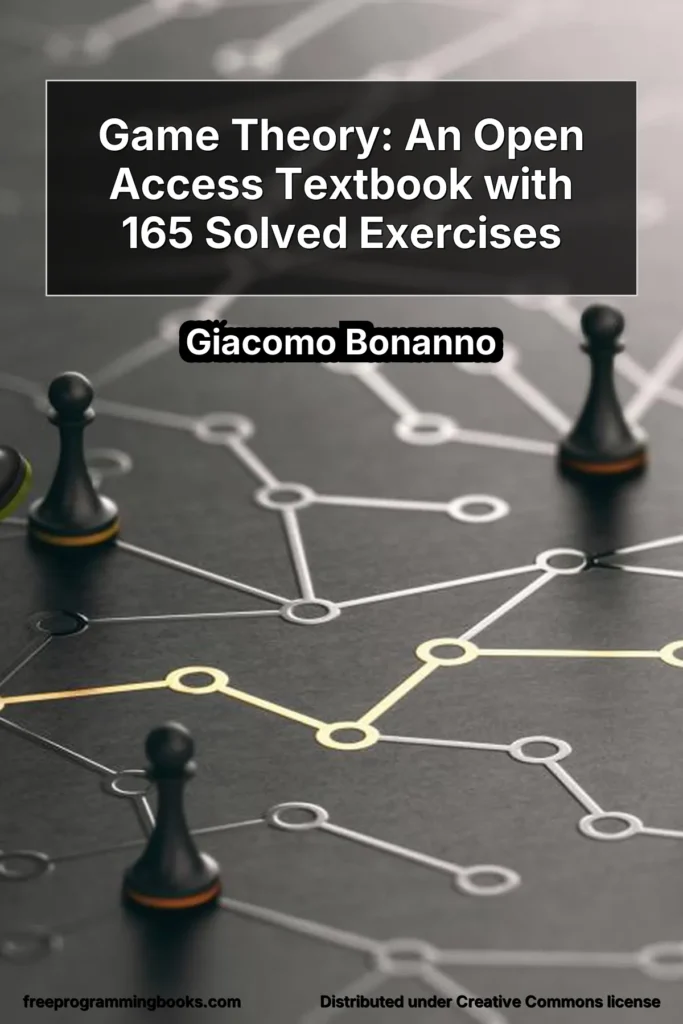
Game Theory: An Open Access Textbook with 165 Solved Exercises by Giacomo Bonanno is a comprehensive and rigorous introduction to game theory. The book is based on over 25 years of teaching experience at the University of California, Davis, and is designed for advanced undergraduate and first-year graduate students.
The author explicitly aims to make the material accessible to readers with minimal mathematical background—high-school algebra and elementary probability are sufficient. No prior knowledge of game theory is required. At the same time, the book maintains a rigorous approach and includes formal proofs throughout.
A distinguishing feature of this textbook is the large number of exercises: 165 in total, each accompanied by complete and detailed solutions. This makes it particularly suitable for self-learners and instructors who value structured practice with feedback.
What you will learn
The book develops game theory from foundational concepts to advanced topics. It covers both strategic-form and extensive-form games, with ordinal and cardinal payoffs. Readers learn how to analyze dominance, Nash equilibrium, backward induction, subgame perfection, and mixed strategies.
The text also explores dynamic games, games with imperfect information, and games with incomplete information. Advanced sections examine knowledge, common knowledge, belief revision, and refinements of equilibrium such as sequential equilibrium and perfect Bayesian equilibrium.
Through the structured progression and extensive problem sets, readers gain:
- A formal understanding of equilibrium concepts in static and dynamic games
- The ability to compute mixed-strategy Nash equilibria
- Tools to analyze strategic interaction under uncertainty and incomplete information
- Familiarity with belief systems, Bayesian updating, and consistency concepts
- Practice applying theoretical results through solved exercises
These concepts are directly applicable in economics, algorithmic game theory, multi-agent systems, and decision modeling.
Table of contents
Preface and acknowledgments
0. Introduction
PART I: Games with ordinal payoffs
- Ordinal games in strategic form
1.1 Game frames and games
1.2 Strict and weak dominance
1.3 Second-price auction
1.4 The pivotal mechanism
1.5 Iterated deletion procedures
1.6 Nash equilibrium
1.7 Games with infinite strategy sets
Appendix 1.A: Proofs of theorems
Appendix 1.E: Exercises [23 exercises]
Appendix 1.S: Solutions to exercises - Dynamic games with perfect information
2.1 Trees, frames and games
2.2 Backward induction
2.3 Strategies in perfect-information games
2.4 Relationship between backward induction and other solutions
2.5 Perfect-information games with two players
Appendix 2.E: Exercises [13 exercises]
Appendix 2.S: Solutions to exercises - General dynamic games
3.1 Imperfect information
3.2 Strategies
3.3 Subgames
3.4 Subgame-perfect equilibrium
3.5 Games with chance moves
Appendix 3.E: Exercises [14 exercises]
Appendix 3.S: Solutions to exercises
PART II: Games with cardinal payoffs
4. Expected Utility
4.1 Money lotteries and attitudes to risk
4.2 Expected utility: theorems
4.3 Expected utility: the axioms
Appendix 4.E: Exercises [14 exercises]
Appendix 4.S: Solutions to exercises
- Mixed strategies in strategic-form games
5.1 Strategic-form games with cardinal payoffs
5.2 Mixed strategies
5.3 Computing the mixed-strategy Nash equilibria
5.4 Strict dominance and rationalizability
Appendix 5.E: Exercises [15 exercises]
Appendix 5.S: Solutions to exercises - Dynamic games with cardinal payoffs
6.1 Behavioral strategies in dynamic games
6.2 Subgame-perfect equilibrium revisited
6.3 Problems with subgame-perfect equilibrium
Appendix 6.E: Exercises [9 exercises]
Appendix 6.S: Solutions to exercises
PART III: Advanced Topics I: Knowledge, common knowledge, belief
7. Knowledge and common knowledge
7.1 Individual knowledge
7.2 Interactive knowledge
7.3 Common Knowledge
Appendix 7.E: Exercises [14 exercises]
Appendix 7.S: Solutions to exercises
- Adding beliefs to knowledge
8.1 Probabilistic beliefs
8.2 Conditional probability, belief updating, Bayes’ rule
8.3 Belief revision
8.4 Harsanyi consistency of beliefs or like-mindedness
8.5 Agreeing to disagree
Appendix 8.A: Proof of the Agreement Theorem
Appendix 8.E: Exercises [12 exercises]
Appendix 8.S: Solutions to exercises - Common knowledge of rationality
9.1 Models of strategic-form games
9.2 Common knowledge of rationality in strategic-form games
9.3 Common knowledge of rationality in extensive-form games
Appendix 9.A: Proofs
Appendix 9.E: Exercises [7 exercises]
Appendix 9.S: Solutions to exercises
PART IV: Advanced Topics II: Refinements of subgame-perfect equilibrium
10. A First Attempt: Weak Sequential Equilibrium
10.1 Assessments and sequential rationality
10.2 Bayesian updating at reached information sets
10.3 Weak sequential equilibrium
Appendix 10.E: Exercises [8 exercises]
Appendix 10.S: Solutions to exercises
- Sequential Equilibrium
11.1 Consistent assessments
11.2 Sequential equilibrium
11.3 Is ‘consistency’ a good notion?
Appendix 11.E: Exercises [6 exercises]
Appendix 11.S: Solutions to exercises - Perfect Bayesian Equilibrium
12.1 Belief revision and AGM consistency
12.2 Bayesian consistency
12.3 Perfect Bayesian equilibrium
12.4 Adding independence
12.5 Filling the gap between Perfect Bayesian equilibrium and sequential equilibrium
Appendix 12.A: History-based definition of extensive-form game
Appendix 12.B: Proof of Theorems 12.4
Appendix 12.E: Exercises [10 exercises]
Appendix 12.S: Solutions to exercises
PART V: Advanced Topics III: Incomplete Information
13. Incomplete Information: Static Games
13.1 Interactive situations with incomplete information
13.2 One-sided incomplete information
13.3 Two-sided incomplete information
13.4 Multi-sided incomplete information
Appendix 13.E: Exercises [8 exercises]
Appendix 13.S: Solutions to exercises
- Incomplete Information: Dynamic Games
14.1 One-sided incomplete information
14.2 Multi-sided incomplete information
Appendix 14.E: Exercises [7 exercises]
Appendix 14.S: Solutions to exercises - Incomplete Information: the type-space approach
15.1 Types of players
15.2 Types that know their own payoffs
15.3 The general case
Appendix 15.E: Exercises [4 exercises]
Appendix 15.S: Solutions to exercises
References
Book details
- Title: Game Theory: An Open Access Textbook with 165 Solved Exercises
- Author: Giacomo Bonanno
- Main category: Mathematics
- Subcategory: Probability
- License: Creative Commons Attribution-NonCommercial-NoDerivatives 4.0 International License (CC BY-NC-ND 4.0)
More books by language: Mathematics, Probability
Legal notice: This book is shared for educational purposes only. The content is distributed under Creative Commons licenses or with explicit permission from the author. FreeProgrammingBooks does not host copyrighted material.