Linux powers everything from smartphones and servers to cloud infrastructure and embedded systems. More than 90% of the cloud runs on Linux, and it remains the dominant platform for developers, system administrators, and DevOps engineers. With the rise of containerization, microservices, and edge computing, understanding the Linux command line is no longer optional for IT professionals — it is a core skill.
The command line offers speed, precision, and automation capabilities that graphical interfaces cannot match. Once you master the shell, repetitive tasks become scriptable, system troubleshooting becomes methodical, and your overall productivity as a developer multiplies.
About the book
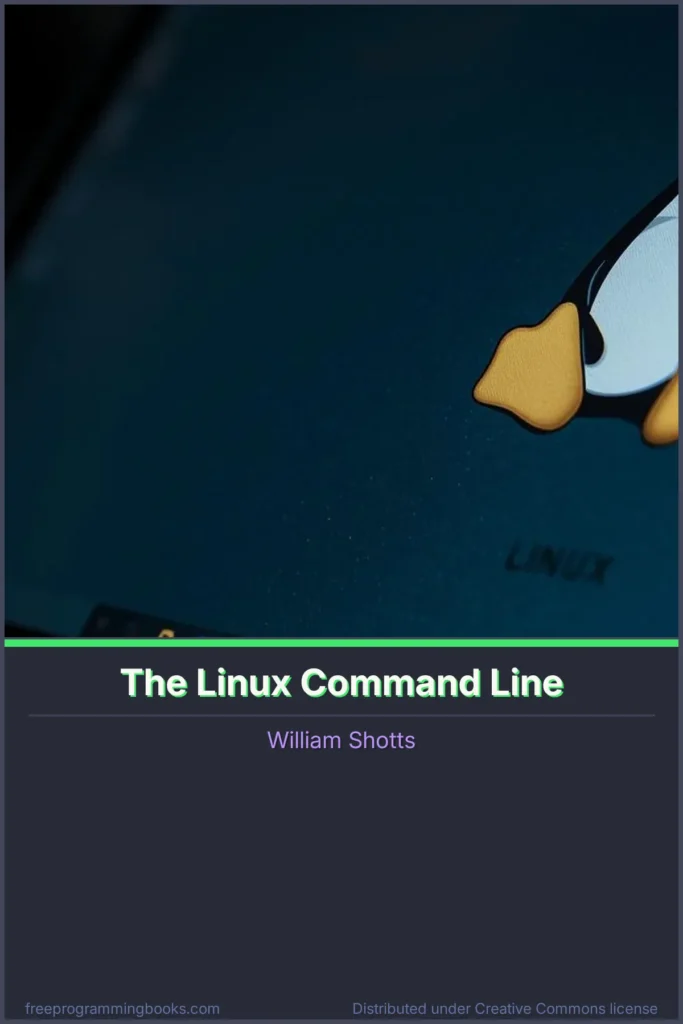
The Linux Command Line by William Shotts is the definitive free guide to mastering the Bash shell. Now in its Seventh Internet Edition (2026), this 597-page volume takes readers from their very first terminal keystrokes to writing complete shell scripts. No prior Linux experience is required.
The book is divided into four parts: Learning the Shell, Configuration and the Environment, Common Tasks and Essential Tools, and Writing Shell Scripts. Each chapter builds on the previous one, gradually introducing commands, concepts, and best practices. The writing is clear, example-driven, and grounded in real-world usage — the kind of knowledge that comes from decades of hands-on experience.
What you will learn
This book covers the full spectrum of Linux command line skills. You will learn filesystem navigation, file manipulation, command chaining and pipelines, text processing with grep, sed, and awk, process management, and environment configuration. The shell scripting section takes you through variables, conditionals, loops, functions, and debugging techniques.
Beyond commands, you will understand the Unix philosophy: small tools that do one thing well, composed together to solve complex problems. By the end, you will be comfortable administering a Linux system, automating tasks, and troubleshooting issues from the terminal.
Table of contents
- Part 1: Learning the Shell
What Is the Shell? — Navigation — Exploring the System — Manipulating Files and Directories — Working with Commands — Redirection — Seeing the World as the Shell Sees It — Advanced Keyboard Tricks — Permissions — Processes - Part 2: Configuration and the Environment
The Environment — A Gentle Introduction to vi — Customizing the Prompt - Part 3: Common Tasks and Essential Tools
Package Management — Storage Media — Networking — Searching for Files — Archiving and Backup — Regular Expressions — Text Processing — Formatting Output — Printing — Compiling Programs - Part 4: Writing Shell Scripts
Writing Your First Script — Starting a Project — Top-Down Design — Flow Control: Branching with if — Reading Keyboard Input — Flow Control: Looping with while, until, for — Troubleshooting — Flow Control: Branching with case — Positional Parameters — Flow Control: Looping with for — Strings and Numbers — Arrays — Miscellaneous Tools
Book details
- Title: The Linux Command Line
- Author(s): William Shotts
- Publication year: 2026 (Seventh Internet Edition)
- Publisher: No Starch Press / LinuxCommand.org
- Pages: 597
- PDF size: 6.1 MB
- Estimated reading time: ~14 h 55 min
- Level: Beginner to Intermediate
- Main category: Systems and Networking
- Subcategory: Linux
- Language: English
- License: Creative Commons Attribution-Noncommercial-No Derivative Works 3.0 (CC BY-NC-ND 3.0)
More books in: Linux, Systems and Networking
Legal notice: This book is shared for educational purposes only. The content is distributed under Creative Commons licenses or with explicit permission from the author. FreeProgrammingBooks may host files that comply with their respective licenses.