Deep learning has become the engine behind most of the recent advances in artificial intelligence, from image recognition and speech processing to large language models. In 2026, deep learning continues to power everything from autonomous vehicles to AI assistants, generative models, and scientific discovery.
The field moves fast, and the gap between cutting-edge research and what most developers understand grows wider every year. Having a clear, concise grounding in the fundamentals is no longer optional for anyone working at the intersection of software and AI.
Many resources in this space fall into two extremes: either they are shallow overviews that barely scratch the surface, or they are thousand-page tomes that bury the reader in mathematical formalism. A book that finds the middle ground — rigorous yet compact — is rare, which is precisely why this one has been downloaded over half a million times.
About the book
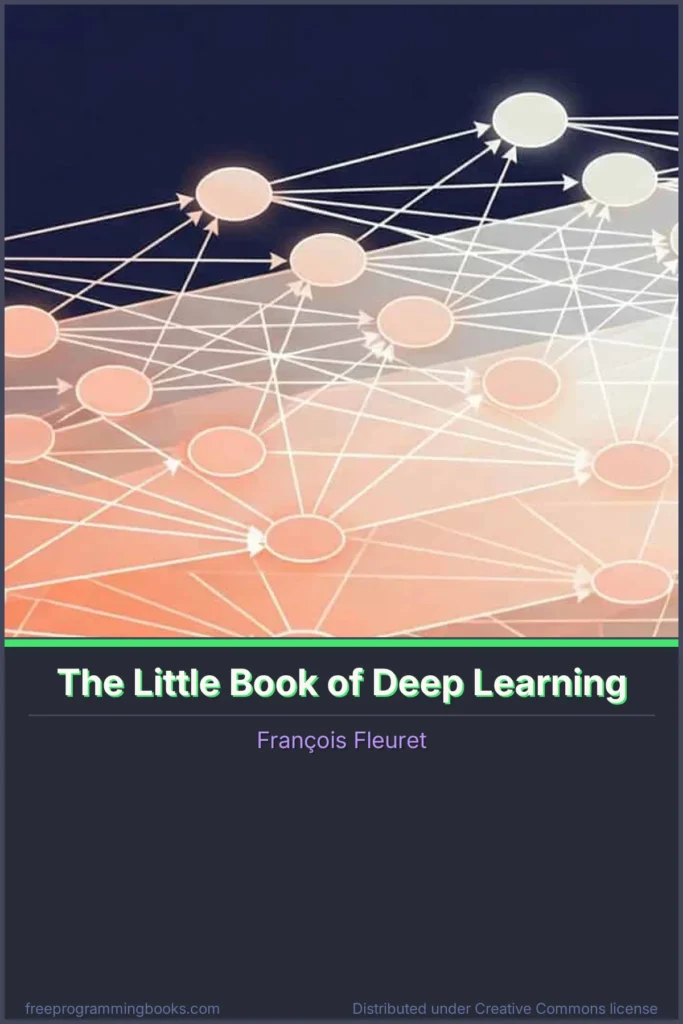
The Little Book of Deep Learning is a short, focused introduction written for readers with a STEM background. It covers the essential concepts, architectures, and training techniques needed to understand modern deep learning models. Rather than attempting to be exhaustive, the book selects a handful of important model families and explains them clearly, from basic foundations to state-of-the-art approaches.
Originally designed to be readable on a phone screen, the book is formatted for quick consumption without sacrificing depth. It assumes some familiarity with linear algebra, calculus, and probability, but does not require prior knowledge of machine learning or neural networks.
What you will learn
This book walks through the complete pipeline of deep learning: from the fundamentals of machine learning and efficient computation on GPUs, through training techniques such as gradient descent and backpropagation, to modern architectural components like attention layers, transformers, and convolutional networks. Later chapters cover practical applications including image classification, object detection, speech recognition, and text generation.
The final chapter addresses the “compute schism” that has emerged in the field, covering prompt engineering, quantization, adapters, and model merging — techniques that allow practitioners to work with large models efficiently even with limited resources.
Table of contents
- Foreword
- Part I: Foundations
- Machine Learning: Learning from data, basis function regression, under and overfitting, categories of models
- Efficient Computation: GPUs, TPUs, batches, tensors
- Training: Losses, autoregressive models, gradient descent, backpropagation, the value of depth, training protocols, the benefits of scale, large-scale parallel training
- Part II: Deep Models
- Model Components: The notion of layer, linear layers, activation functions, pooling, dropout, normalizing layers, skip connections, attention layers, token embedding, positional encoding
- Architectures: Multi-layer perceptrons, convolutional networks, attention models (Transformer, GPT, ViT)
- Part III: Applications
- Prediction: Image denoising, classification, object detection, semantic segmentation, speech recognition, text-image representations, reinforcement learning
- Synthesis: Text generation, image generation
- The Compute Schism: Prompt engineering, quantization, adapters, model merging
- The missing bits
More books in: Artificial Intelligence, Deep Learning
Legal notice: This book is shared for educational purposes only. The content is distributed under Creative Commons licenses or with explicit permission from the author. FreeProgrammingBooks may host files that comply with their respective licenses.